
Diabetes is the line item finance already sees, through group insurance claims. Prediabetes is the one nobody has counted — larger, invisible, and the only stage where the trajectory can still be changed cheaply.
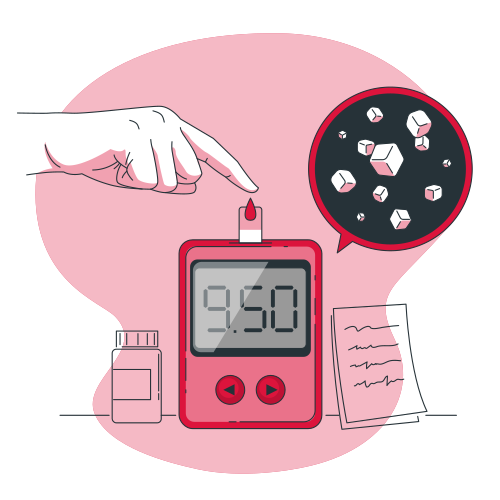
Applying national prevalence to a workforce of 1,000 adults suggests roughly 114 people with diabetes and 153 with prediabetes. Your actual numbers will differ with age profile, location and job type — a young engineering team and a factory floor with a median age of 45 are not the same population — but the order of magnitude is the point.
Of those two groups, the second is larger and almost entirely undiagnosed. Prediabetes produces no symptoms, so nobody presents with it, and a routine check-up that reports a fasting glucose as “within range” can miss years of developing insulin resistance.
Be careful with published cost figures. The Indian cost-of-illness literature measures what patients and their households spend — the ₹17,080 pooled annual figure above is out-of-pocket and household expenditure, not your cost. Quoting it as an employer cost would overstate the case.
Employer exposure runs through three different channels: group medical insurance claims and the premium loading that follows them, absence, and reduced output while present. The nationally representative LASI analysis of 72,250 respondents measures that last category directly, across absenteeism, presenteeism, job interruption and early withdrawal from the workforce — though it covers ages 45 and over, so it describes your senior cohort rather than your whole headcount.
We do not publish a generic rupee figure for what this costs you, because a number derived from someone else's workforce is not evidence about yours. The ROI calculator models it from your headcount, age profile and premium.
Employees with diagnosed diabetes are already in the medical system, and their care is largely a clinical matter. The prediabetes group is different: the condition is considered modifiable, the interventions are behavioural rather than pharmaceutical, and they cost a fraction of managing established disease.
The catch is that you cannot run a programme for a group you have not identified. That is a screening problem before it is a wellness problem.
Every figure on this page comes from one of the following, checked against the published source before use.
The ROI calculator models this against your own headcount, age profile and premium. A Health Risk Assessment replaces the modelling with what is actually present in your workforce.